

An agentic system that reads, validates, and adjudicates healthcare claims. Routine cases follow policy rules; complex ones reach handlers with the evidence already assembled.
See the AI claims management software this became ↗Every claim read, checked, and decided by hand
Claims arrived as PDFs, emails, and scanned post. Each one was read, cross-checked across several systems, and decided by hand: days per claim, inconsistent outcomes, and a backlog that tied up senior handlers on routine work.
The trust needed routine claims to move without human touches, and complex ones to reach the right person with context attached.
Six stages, one pipeline
Intake & digitisation
An LLM extraction layer parses every incoming document into a structured claim record.
Validation & enrichment
Cross-checked against membership, coverage, and tariff schedules. Missing information is requested automatically.
Risk & anomaly scoring
Each claim is scored for anomalies, tariff variance, and complexity. Every score is explainable.
Adjudication
Claims within thresholds set by the trust settle automatically: decision, rationale, and payment instruction drafted by the agent.
Routing & escalation
Flagged claims reach the right handler with evidence, risk profile, and a draft assessment attached. No claim arrives cold.
Audit & learning
Every step is logged as it happens, to IG standards. Handler overrides feed back into the models.
Watch it work
Handlers only see claims that need judgement.
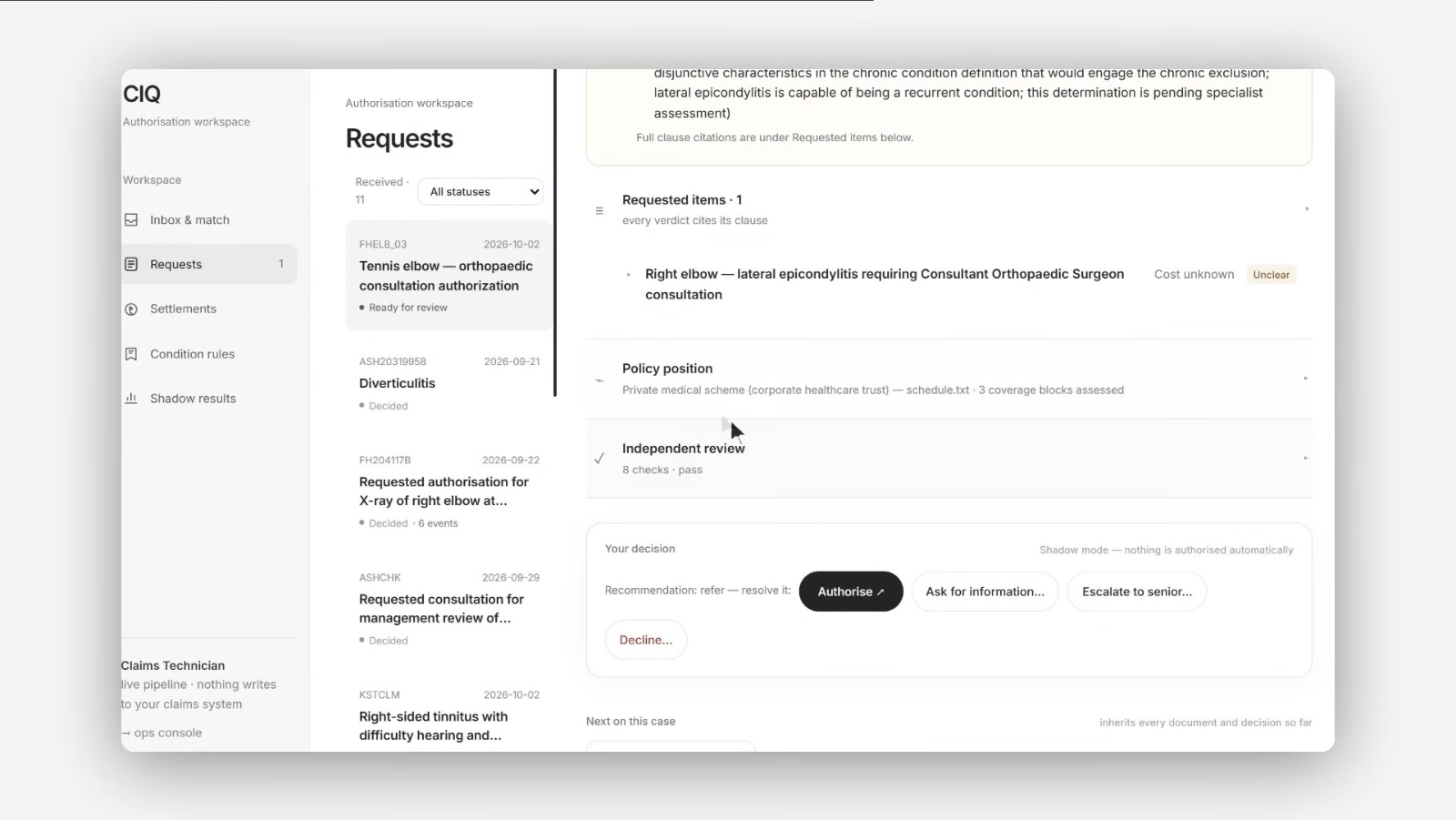
Evidence at the point of decision
Policy rules guide the assessment, with exceptions routed for review.
Complex cases reach a handler with supporting evidence already assembled.
The assessment records its rationale and the sources used at decision time.
What it runs on
Models & agents
- LLM document extraction
- Adjudication agents
- Anomaly & risk models
- Explainability layer
Platform
- Databricks lakehouse
- Unity Catalog
- Azure
- IG-compliant data handling
Operations
- Human-in-the-loop review
- Eval suites
- Threshold controls
- Full audit logging